Friday, November 15, 2013

The Benefits and Advantages of Cloud Storage

In the world today technology continues to rapidly advance and improve. This is true not only in the entertainment world with things like 4K TVs and new video game systems, but also in the business world and in technology that people can use on the go. There is perhaps no better area that this is evident than in the area of data storage, specifically "cloud storage".

To someone that works on the go or someone that is frequently using different devices to access files and work, cloud storage is in many ways a dream come true. In essence, cloud storage is a backup and storage service on the internet. Cloud storage allow people and businesses to sync files, photos, videos, and much more across a wide range of devices and can be accessed from anywhere there is an internet connection. While the adaptation and growth of cloud storage started off slow, it has grown rapidly over the last couple of years and there are now many different companies that offer cloud storage solutions for both individuals and for businesses.

Perhaps the greatest benefit of cloud storage, other than a backup of your files that can be accessed from anywhere there is internet, is the ability to sync everything in your cloud storage to so many different devices. In the past, traditional desktop and laptop computers were the only way to access files stored on the cloud. However, with the rapid advancements made in mobile technology, smartphones and tablets can also access, view, and edit many of the files that are stored in the cloud. This is a great advantage for anyone that works on the go as they can pull up that spreadsheet while riding the bus, view and study a PowerPoint presentation while sitting at the airport, or view photos and videos while eating a bite of lunch. In addition, many of the popular cloud storage services allow you to save files to your smartphone or tablet to view them even when you do not have a internet connection.

As cloud storage has continued to grow, so have the number of organizations that offer cloud storage solutions. While there is perhaps no perfect storage provider that can meet the needs of everyone, there are a few that tend to stand above the rest. The three most popular and perhaps best storage solutions are Dropbox, Google Drive, and Microsoft SkyDrive. All of these providers offer free cloud storage up to a certain limit ranging from 2 GB to 15 GB, and also offer paid subscription plans for much greater storage capabilities. For example, Google Drive offers people with a Gmail account and a Google+ account 15GB of storage with the option to increase storage to 16 TB. All cloud services have different benefits and bonuses, the great thing about the expanded field of choices is the ability to chose the right one for you.

In the end, cloud storage may not be the perfect solution for storing all you data. Plans can be expensive for large storage options and security can occasionally be a concern. It is however a useful tool for the right data and a huge benefit for people that use many different devices. One tip is that people should not put all of their files online nor should they keep them only on the cloud. It is a good idea to keep a physical backup of your data where you can always retrieve it if you cannot access the internet or the company has issues syncing your files.There are always going to be some risks to relying on the internet for your files, though as technology advances this is becoming less and less of a problem. Ultimately though, if you can find the right storage provider that meets your needs and can utilize the "access anywhere" capability of cloud storage, than working on the go may just get a little bit easier for you.

Monday, September 30, 2013

Harnessing Microwave Energy


Usually the first, and only thing that comes to mind when you think about your microwave is that it will heat up your food quickly, so you can eat it when you're ready to. This may not be the only function you think of when you hear the word "microwave" much longer, these kitchen appliances may also be used to charge your phone in the future. Research is being done in Tokyo Japan to make this far fetched idea into reality.

At first, a microwave that charges your phone seems a little ridiculous, but most people don't know that a microwave emits a lot of wasted energy, that could potentially be used for something like keeping your phones battery charged. A man name Yoshihiro Kawahara is leading a team of researchers that are designing a device that can harness and recycle all of that wasted energy and use it for practical things like charging smaller batteries in other devices. This idea was inspired by NASA's attempt at harnessing waste energy produced by the sun and using it as yet another alternative energy source.

Although we probably won't see this phone charging microwave in the immediate future due to regulations on how much energy microwaves are allowed to emit, the advancements are definitely something that can be used in many beneficial ways. As this technology is updated it will absolutely help people easily reduce their carbon footprint by recycling a lot of energy, that is usually considered to be wasted. I know that I personally feel like this is a great idea, and as it is refined it will dramatically decrease the amount of energy we waste on a daily basis.

Friday, September 20, 2013

Cat Paw Breaches Through iPhone 5S Fingerprint Scanner

So now that the iPhone 5S has been out for a few days or so, this is when the fun starts. All the bugs will begin to show themselves. One such bug that many did not expect to see is actually affecting one of the biggest features of the iPhone 5S: the fingerprint scanner. Now the issue with this feature that is now being reported is not that it doesn't unlock due to sweater fingers, but that it opens and accesses your phone with things other than your fingerprint. Everything from your palm, to your forearm, and now even a cat's paw will do the trick.

This is not shaping up to be a good look for Apple's new iPhone, and albeit that we should expect bugs in the new feature, I don't believe that anyone was expecting an animal to be able to access their phone.  With so many people upgrading their phones and getting the new iPhone, it can be very risky to consumers with jobs that require a level of security. The fact that this feature was looked at as one the the main reasons to buy the new 5S is only giving this phone a bad look in terms of security. This news has now become so important that now even hackers are getting involved with this as well.

With the hackers offering a fairly handsome reward, it can only be assumed that the information on how to hack the new scanner properly would be used for malicious intent. The reward has been increasing steadily as well, so now hackers will have a little more incentive. The act of "lifting" someone's fingerprint seems to be the best way to go about tricking the new scanning feature. Supposedly there a few different ways to go about doing this, so now it begs the question, how secure is your new iPhone 5S really?

Now that these issues are starting to arise with the new Apple device, one can only hope that they are working around the clock to try and figure out the issue and resolve it. The main concern with that is that we, as the consumer, can't be sure whether the issue is in the hardware or the software. The only real failsafe involving the scanner is that a numeric passcode is required if the phone is left untouched for at least 48 hours. It hasn't been long that the new 5S has been out and with issues like this already occurring, it doesn't look good for Apple right now.

Monday, September 16, 2013

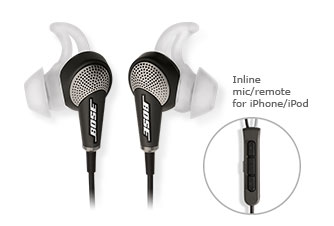
Bose QuietComfort 20i Acoustic Noise Cancelling Headphones

By Michael Luciano

We have all been there. That time when you are listening to your favorite song at such a high decibel that you start to get the "look" from passersby. Some of us only do that for the sake of being able to hear it within areas where it can be nearly impossible to enjoy our music. This is where the noise cancelation headphones come in, only this time, they are a bit smaller.

Bose has introduced a much more condensed version of their top of the line, noise canceling headphone, now in the form of ear buds. The new Bose QuietComfort 20i has got many features that not a lot of people would expect from noise cancelation headphones, especially not in ear bud form. Featuring a rechargeable battery for the noise canceling feature eliminates all need for batteries. This alone takes away a common expense for most headphones of this type. It also allows for ambient noise to peak through when you need it to, by the means of an "Aware" mode. Always good for when you are walking through a bustling city.

While all of these features are good, there is always a downside to something that seem to good to be true. With $299 being the cheapest price for these beauties, it's not likely to see an average consumer shell out this amount of money for headphones, but it is definitely a top contender, especially seeing as it's design is suited for more practical use than most headphones. Still, these are going to need a bit of a price adjustment before I decide to pick up my pair.

Source: Bose.com

Tuesday, September 3, 2013

Application Strategy in a Mobile World

Did you know 64% of the time spent on mobile phones is spent on apps? Ever since the start of mobile applications in the late 20th century our world has been changed. Mobile apps have been on the rise, and our society has developed an “I need it yesterday” mentality. We all think, the quicker the better and mobile applications play a key role in that. With the rise in this field people may be asking “What makes a good application?” or “What are the key components to create an application that will take off in the market place?"

There are a few things to look at when developing an application for your business or for your personal needs. The main thing is why; why do you need this app? Finding the underlying issue will help develop an applications that meets that specific need. Another key component is making your application user friendly. No one wants to use an app that they hate or is difficult for them to use. Make your application simple, to the point, and flexible. Always leave room for change and improvements. One last key component people look for in an app is price. Far more people go for a free application over one that costs; even if it is only $.99. You can always have extra content that a user would have to pay for once they've downloaded the app.

In other words, in creating an application always think of the user. Make sure it solves a specific need and that it is user friendly and easy to use. By doing these things you will always leave people wanting to come back for more.

Wireless technology simply allows small business enterprises to make up in flexibility, speed and efficiency for what they might lack in workforce and physical infrastructure. Looking for help, and a smile, on your mobile technology rental needs for your next event or show? If so check out our full line of tablet rental options!

Wednesday, April 17, 2013


Samsung's new flagship phone, the Galaxy S4, will make its debut in the US next week.
Pricing and availability vary a bit carrier to carrier, but here's what we know so far:
  • T-mobile will begin selling the Galaxy S4 on April 24. It'll cost $149.99 up front, plus $20 per month for 24 months.
  • AT&T is now accepting pre-orders for the Galaxy S4, starting at $199.99 with a two-year contract. We're still waiting for a launch date.
  • Sprint will sell the Galaxy S4 on April 27 for $249.99 with a two-year contract. New customers switching from another carrier can get the phone for $149.99.
  • Verison has not announced pricing or availability for the Galaxy S4, but has confirmed it will sell the device.
  • U.S. Cellular has not announced pricing or availability for the Galaxy S4, but has confirmed it will sell the device.


Friday, April 5, 2013

32GB HTC One Coming to AT&T and Sprint on April 19

AT&T and Sprint recently announced, albeit separately, plans to begin selling 32GB HTC One smartphones starting April 19 for $199.99 with a new two-year contract. In addition to that, AT&T said that it will be the only carrier in the United States to launch a 64GB version of the HTC One. That version of the smartphone will sell for $299.99 with a new two-year contract.

T-Mobile also announced that it will begin selling the HTC One "sometime in the spring", and said that it will charge $99 down with 24 equal payments of $20 in a low-subsidy, no contract plan. Online reservations for AT&T's HTC One began Thursday, April 4. Sprint began reservations on Friday, April 5.

AT&T will also be offering a free HTC Media Link HD wireless HDMI adapter with the device for a limited time. The device will allow you to connect your HTC One to an HDTV. However, you will also have to sign a separate two-year agreement for the adapter as well. AT&T and Sprint also confirmed that the HTC One will be available in both black and silver.

The HTC One comes with a 1.7 GHz quad-core processor, an aluminum case and has a 4.7" full HD screen. It comes equipped with Android 4.1 for its operating system as well as a new HTC Sense interface that is comparable to the tiles used in the Windows Phone 8. The device will also run on AT&T and Sprint's LTE wireless networks and comes with a 2300 mAh battery.

The only carrier to not announce availability for the HTC One was Verizon, who declined to comment on plans for the smartphone. It seems unlikely that the carrier will have the device, especially considering the fact that HTC doesn't list Verizon as a carrier on its website.

When the device was announced back in February, one of the biggest innovations that HTC was highlighting was the Ultrapixel camera. This camera has been designed to take better photos in low light than traditional cameras and is rated at 4 megapixels. However, HTC argues that it is capable of capturing more light and uses fewer, though larger, pixels for better pictures.

Like I said earlier, reservations for the HTC One are available on AT&T and Sprint, so if you've been waiting for the opportunity to get yours, then don't wait any longer! Head on over to AT&T or Sprint's website and reserve yours before they all run out!

Source: Computer World - HTC One with 32 GB available from AT&T, Sprint on April 19 for $200 and two-year contract